.................................. Return to Sumner's Home Page....
Return to N Scale RR Main Menu........ Return to Soldering Menu
=========================================
..............Previous Page..............................Next Page If There Is One
=========================================
…..................--- Solder & Fluxes ---
=========================================
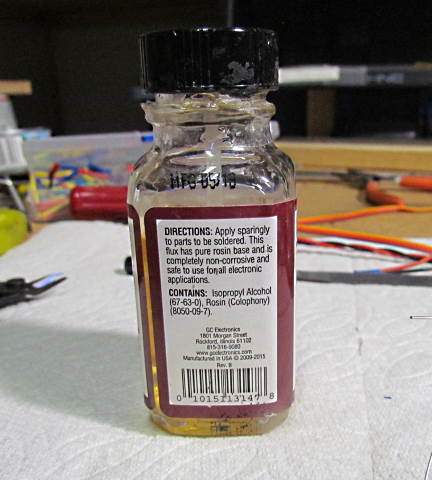
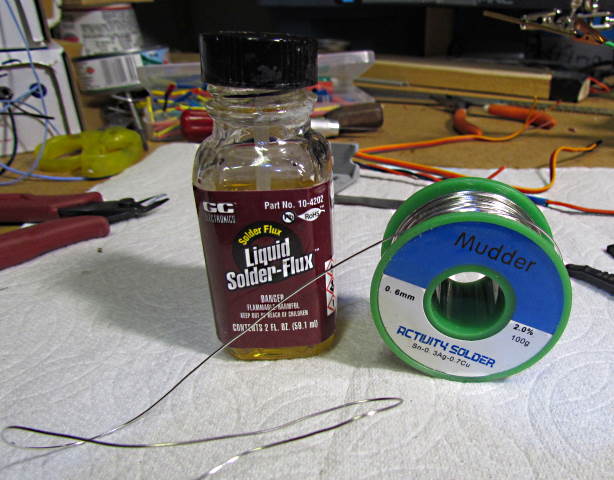
I keep the GC Electronics liquid solder-flux shown above on hand but now I'm a bigger fan of Superior No 30 gel and liquid further down the page. I use the GC or Superior sparingly on most solder joints.
I like the Mudder rosin core lead free solder also and use it for the hand-laid turnouts also. The .6 mm solder seems to work well for both jobs. I bought some .3 Mudder solder but it is too thin for most soldering jobs. I've also used Maiyum .8mm rosin core solder with equally good results.
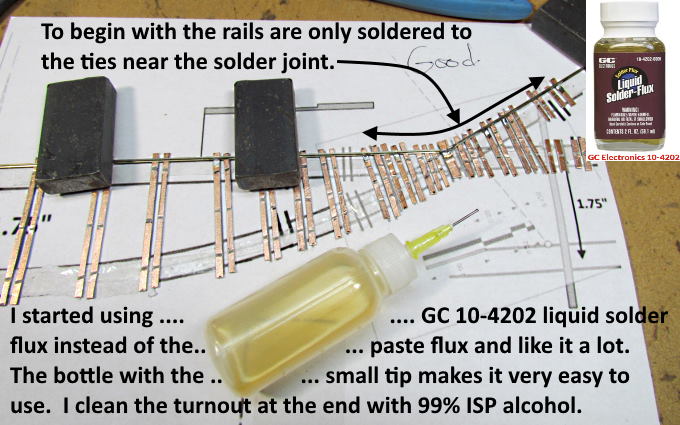
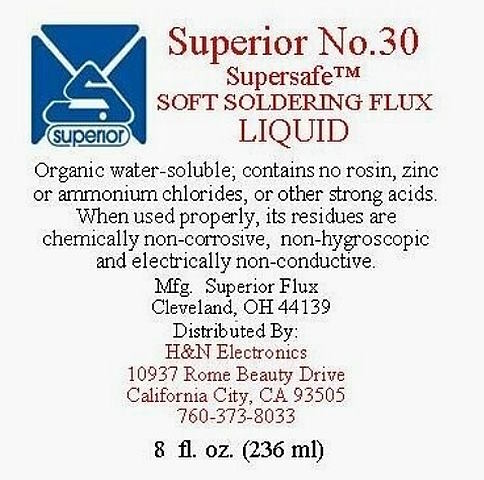
According to the label the liquid flux is safe for all electronic applications. I haven't see any ill effects from using it. Using it the solder joint goes very quickly with a hot iron. I leave the irons on the highest settings for most soldering and on small wire and parts like this you usually have a good solder joint in only a second or so. On and off the joint is usually the case.
NOTE: When I finish a turnout I brush it down with 99% Isopropyl Alcohol using an old toothbrush. Just takes a few minutes and removes any stray sticky flux that remains. They say you should do the same with most fluxes if you are soldering up a PCB. Wiring individual wires or tinning them I don't worry about cleaning as you burn it all off. The Superior #30 below cleans up, if you need to do it, with soapy water which is really nice.
Another thing I should of done a long time ago is …
… to use a bottle with a small dispenser tip to put the flux on vs. micro brushes. Don't use as much, easier to apply and can control the amount much easier. I'd recommend not putting doing this off like I did.
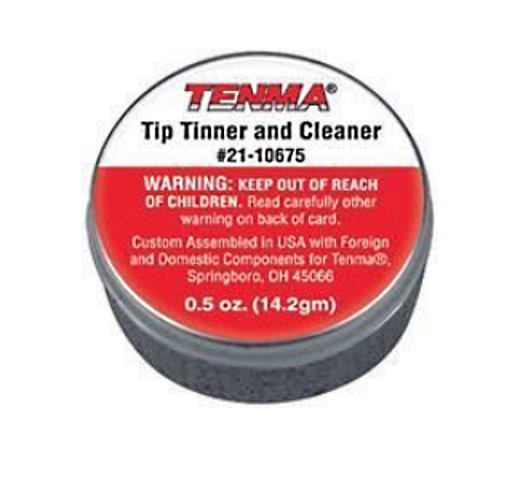
I clean my iron tip between almost every solder joint even if I'm doing dozens with the sponges in the cleaning stations shown on the previous page. Before wiping on the sponge I use a tip cleaner....
… like the one above or one similar. If you still can't get the tip tinned and/or solder to stick to it you need to replace it.
Solder Flux:
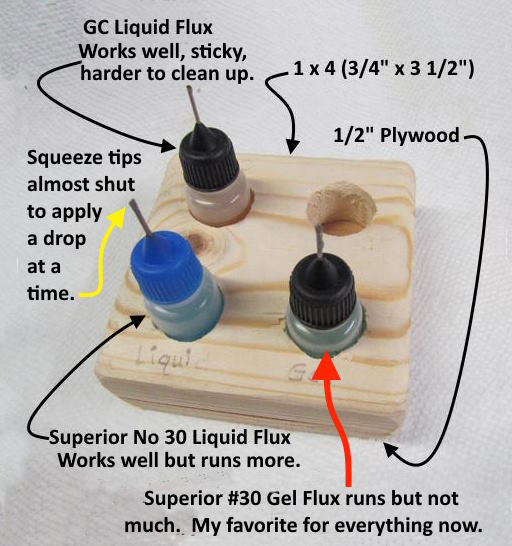
For soldering flux I like ( THESE ) small bottles I bought. For the flux I use the small metal tip and pretty much smash it shut so that when soldering I can control a small drop at a time if I want that for the solder joint on wiring or on turnouts.
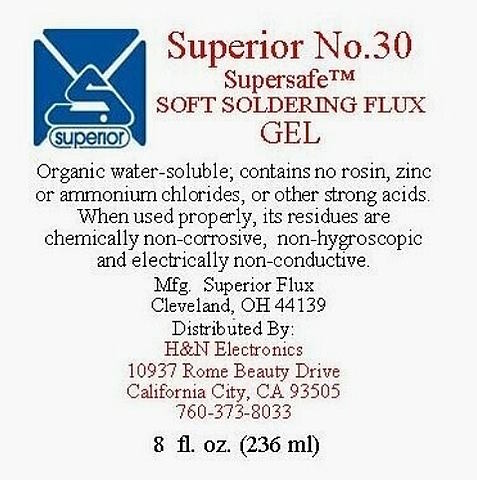
I've used a number of different fluxes for turnouts and wiring and my favorite now is Superior No. 30. I like it better than the pure pastes that take longer to apply with a mico-brush. I like the #30 on the turnouts as it runs far enough for the PCB tie/rail soldering joint and not further.
The Superior flux is non-acid and non-rosin so cleans up much easier and works great.
I read where others were using them for turnout construction so decided to try them after putting it off a year or so. Glad I gave them a try and wish I would of sooner. They are harder to find. I ordered direct (see links) and they came quickly. I now use the #30 for anytime I need more flux than what is in the solder itself, like tinning solder pads and soldering track drops to the rails.
Above are the applicator bottles I use with the flux. I smash the metal tips in some to slow the flow. I like it to not flow out unless I'm squeezing the bottle some.
I also ….
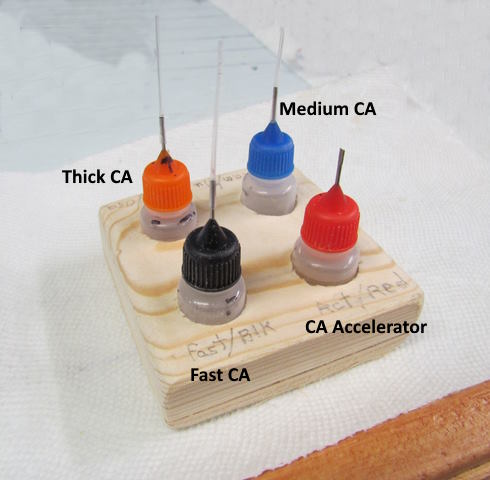
….. use similar bottles for the fast, medium and thick CA glues that I use. If you have problems with the glue hardening in the tips....
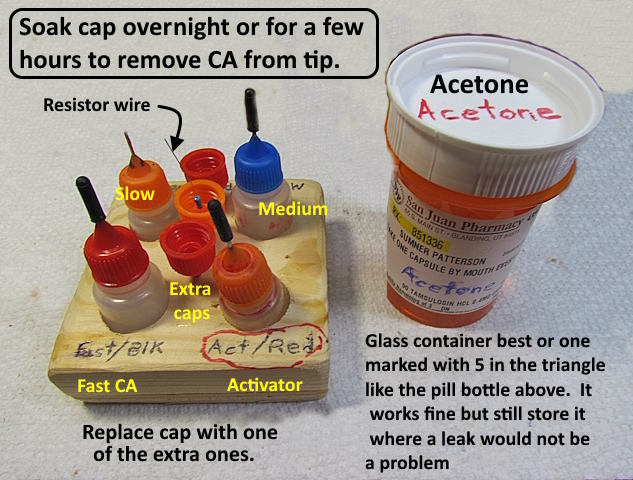
.... after use soak the cap & tip in Acetone. Usually a few hours will do it or overnight if it is older.
I don't try to remove the CA from the tip anymore. I remove the cap, throw it in the Acetone and put one of the extra caps on when I finish gluing. When I remove the cap from the Acetone I check the tip to see if it is open by running the wire on a resistor down through it and move it to the extra cap location.
Best to keep the acetone in a glass bottle but a plastic one with a '5' in the triangle (bottom of bottle) is suppose to be safe. The pill bottle is marked with a 5 on the bottom and I've had the acetone in it for a few weeks as I write this with no problems. I also keep it on the concrete floor of the shop in case it would leak but it hasn't. Don't use other plastic containers.
=========================================..
.................................................. Next Page If There Is One
=========================================
...........................On..............e.......